

Why Vacuum Infusion Makes a Better Kayak
At Bold Coast Boats, we don’t just build kayaks—we craft high-performance, adventure-ready boats designed to handle the toughest ocean conditions. One of the key technologies we rely on is Vacuum-Assisted Resin Transfer Molding (VARTM), or simply, vacuum infusion. This process allows us to make our kayaks lighter, more responsive and efficient, stronger, and more durable. Combined with our carefully chosen composite materials, vacuum infusion gives our boats the edge serious paddlers need.
A typical hand layup is made by placing reinforcing material in a mold (this may be woven fabric or Chop Strand Matt [CSM]). Each layer is then secured in the mold with a coating of resin that soaks in and wets out the material. As more reinforcements layers are added, more resin is applied as needed. The resin is either brushed on or applied with a roller. The boat builder uses their judgement regarding where more resin is needed. While this is a time-tested method of building boats, there is a better way.
What is Vacuum Infusion?
Think of vacuum infusion as a way to make the strongest, most precise composite possible. Instead of manually wetting out fabric with resin, we place dry fabric layers into a mold, then seal a bag over the top and pull out all the air, then pull epoxy resin through the material using vacuum pressure. This method ensures that every fiber is fully saturated while eliminating excess resin—resulting in a stronger, stiffer, and lighter boat compared to traditional hand layups.
Why Vacuum Infusion Makes a Difference
1. A Lighter Kayak Without Sacrificing Strength
Excess resin is dead weight. With vacuum infusion, we precisely control how much resin goes into the laminate, ensuring an optimal fiber-to-resin ratio. The result? A kayak that’s as strong as it needs to be without carrying extra, unnecessary weight. A lighter boat means easier transport, better efficiency and responsiveness on the water, and less paddling fatigue—key benefits for both performance paddlers and expedition adventurers.
2. Stronger, More Reliable Construction
Since the air has been pulled out there are no possibility of air pockets which may cause weak spots that can lead to structural failures over time. Traditional hand layup methods often have inconsistencies, but vacuum infusion ensures every kayak we produce has uniform strength, impact resistance, and durability.
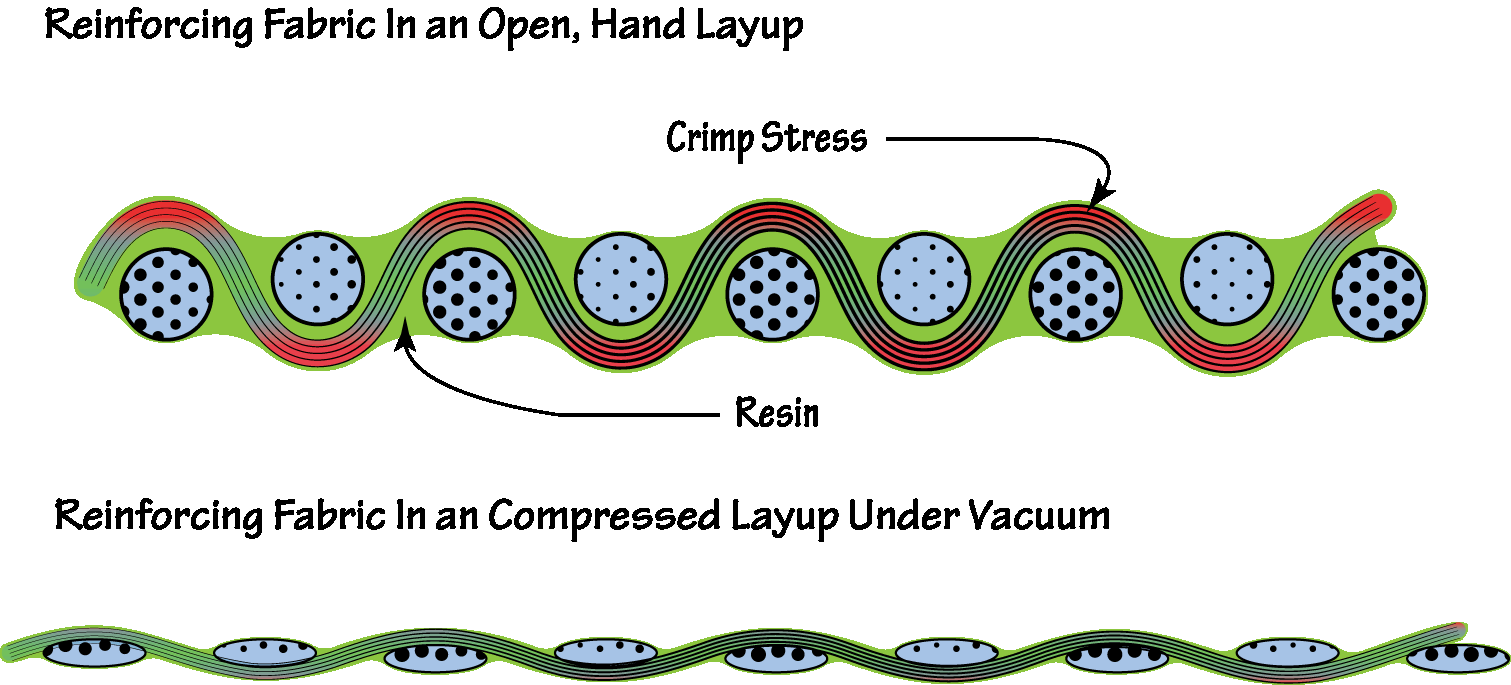
The Fabric is Stronger if it is laid up Under Compression
This exaggerated illustration shows the difference between reinforcing fabric in a Hand Layup on top and under compression in a vacuum infusion scenario. The fibers at the top curve over and under each other in the weave, this creates crimp stress in the yarns. The bulky fabric has more empty space that is filled with resin. After compaction the weave is flattened so the yarns do not need to bend as much and there is less volume that needs to be filled with resin.
3. Optimized Fiber Orientation for Maximum Performance
Vacuum infusion also improves fiber orientation. When we apply vacuum pressure, the fabric layers are compacted, straightening out fibers and reducing waviness. Why does this matter?
Straighter fibers handle loads better. You can’t push a rope and a rope doesn’t hold a load until the slack is taken out. While the resin holds the fibers in place, the fibers don’t achieve their full strength until the fibers are aligned with the loads they are resisting.
Straight fibers have less stress. Bends in the fibers create “crimps” or stresses in the individual fibers. Fibers that are crimped or misaligned introduce weak points where stress can concentrate. By keeping the fibers straight, vacuum infusion allows the kayak to better resist flexing and deformation under pressure.
Stronger and stiffer construction. When fibers remain in their intended orientation, they distribute loads more effectively, resulting in a boat that feels more responsive and solid in the water. Tapping on our boats produces a bell-like tone you don’t detect in less optimized layups.
More predictable performance. Misaligned fibers can create inconsistencies in how a kayak responds to stress. With vacuum infusion, each boat performs exactly as designed, ensuring reliability in demanding conditions.
4. The Myth of Heavier Boats Being Stronger
Some people assume that a heavier boat must be stronger, but in reality, too much resin in a composite layup can actually weaken the structure. Here’s why:
Excess resin creates brittle laminates. Resin alone is rigid but not particularly strong; the real strength comes from the fibers. When there’s too much resin, the composite becomes more prone to cracking under impact or flexing forces.
Lower fiber-to-resin ratio reduces performance. Strong composite materials rely on a balance of fiber and resin. Too much resin means there’s less fiber reinforcement, resulting in a weaker structure overall.
Added weight without added benefit. More resin doesn’t contribute to strength—it just makes the kayak heavier. This unnecessary weight makes paddling harder and less fun without improving durability or performance.
Strength and Weight Advantages Over Hand Layups
This is not a criticism of open layup boats. A well-made hand layup can still produce a strong composite, but vacuum infusion offers significant advantages in both strength and weight reduction. It is a way to make great boats even better.
Higher Fiber Volume Fraction (FVF): Vacuum infusion typically achieves a fiber-to-resin ratio of 60:40 or better, compared to 40:60 to 50:50 for a high-quality hand layup. Since fibers provide most of the strength, vacuum-infused composites are often 20-30% stronger in tensile and flexural strength.
Better Fiber Alignment: Vacuum compaction straightens fibers, reducing waviness and improving load distribution. This can improve tensile strength by 10-20% compared to a hand layup.
Lower Void Content: Hand layups can have 1-3% voids, whereas vacuum-infused laminates typically have less than 1%, leading to better durability and fatigue resistance.
Significant Weight Savings: Vacuum infusion removes excess resin, typically reducing weight by 15-25%compared to a hand layup. For example, a 50 lb (22.7 kg) hand-layup kayak could weigh only 40-43 lbs (18-19.5 kg) when vacuum infused, without sacrificing strength.
The Role of Advanced Composite Materials
The materials we use in our boats are just as important as the manufacturing process itself. We’ve carefully selected a mix of high-performance fabrics to balance strength, impact resistance, and weight savings.
Understanding the Key Fibers in Our Layups
Each fiber in our composite construction brings unique benefits. By combining these materials, we create a kayak that maximizes performance, durability, and efficiency.
Carbon Fiber: Known for its incredible stiffness and light weight, carbon fiber enhances structural rigidity, reducing flex and increasing responsiveness. It has a high strength-to-weight ratio, making it ideal for performance-oriented kayaks.
Fiberglass (Biaxial 45°/-45°): A versatile and cost-effective material, fiberglass adds toughness and flexibility. The biaxial material improves shear strength and torsional rigidity, allowing the kayak to resist twisting forces, enhancing control and stability in rough conditions.
Innegra: This high-impact resistant fiber helps prevent cracks and failures by distributing impact forces. It’s also naturally buoyant, which is really irrelevant to our needs but still kind of interesting. Note the Innegra serves much the same function as Kevlar with lightweight toughness, but resin bonds to Innegra better, and it does not absorb water and holds up better to UV exposure.
Basalt: Derived from volcanic rock, basalt fiber provides excellent impact resistance and vibration dampening. It’s more durable than fiberglass and complements Innegra well, ensuring toughness while maintaining lightweight properties.
Material Properties:
| Property | Innegra | Carbon Fiber | Fiberglass | Basalt |
|---|---|---|---|---|
| Density | Very Low | Low | Moderate | Low |
| Impact Resistance | Excellent | Poor | Moderate | Good |
| Stiffness | Low | Very High | Moderate | High |
| Weight Savings | Excellent | Excellent | Moderate | Good |
| Cost | Moderate | High | Low | Moderate |
Ultra Performance Layup: Carbon Fiber + Basalt/Innegra + Carbon Fiber
For paddlers who demand the lightest, stiffest kayak possible, our "Ultra Performance" layup delivers.
Carbon Fiber: Ensures maximum stiffness and weight savings for a crisp, responsive feel on the water.
Basalt/Innegra: Adds impact resistance and prevents structural failure without increasing weight.
Layered Construction: The strategic placement of these materials enhances strength while maintaining an ultra-light build.
Expedition Layup: Basalt/Innegra + Biaxial Fiberglass + Basalt/Innegra
For those who need a kayak tough enough to handle extended trips and rough conditions, our "Expedition" layup is built to last.
Basalt/Innegra: Provides excellent impact and abrasion resistance, protecting against the wear and tear of long-distance adventures.
Biaxial 45°/-45° Fiberglass:
Enhanced Shear Strength and Torsional Rigidity: Resists twisting forces for a controlled, stable ride.
More Effective Load Distribution: Absorbs impact forces evenly, improving durability and longevity.
Smoother Flex and Responsiveness: Balances stiffness and flex, ensuring the kayak absorbs shock while maintaining structure.
Why Bold Coast Boats Stand Out
The reinforcing fabrics we use are not chosen for their aesthetic appearance. We select them based how they will allow the kayak to perform. At the end of the day, vacuum infusion and premium composite materials make our boats:
Lighter: Easier and more responsive to paddle, transport, and handle on and off the water.
Stronger: With improved impact resistance and structural integrity for long-lasting performance.
Optimized for Performance: We are creating efficient and agile boats. From casual day trips to extreme expeditions, our kayaks are built to handle whatever adventure you throw at them.
Vacuum infusion isn’t just a manufacturing choice—it’s a commitment to building better boats. By fine-tuning the process and pairing it with the right materials, we create kayaks that are stronger, more durable, easier to transport, and most importantly more fun to use.
